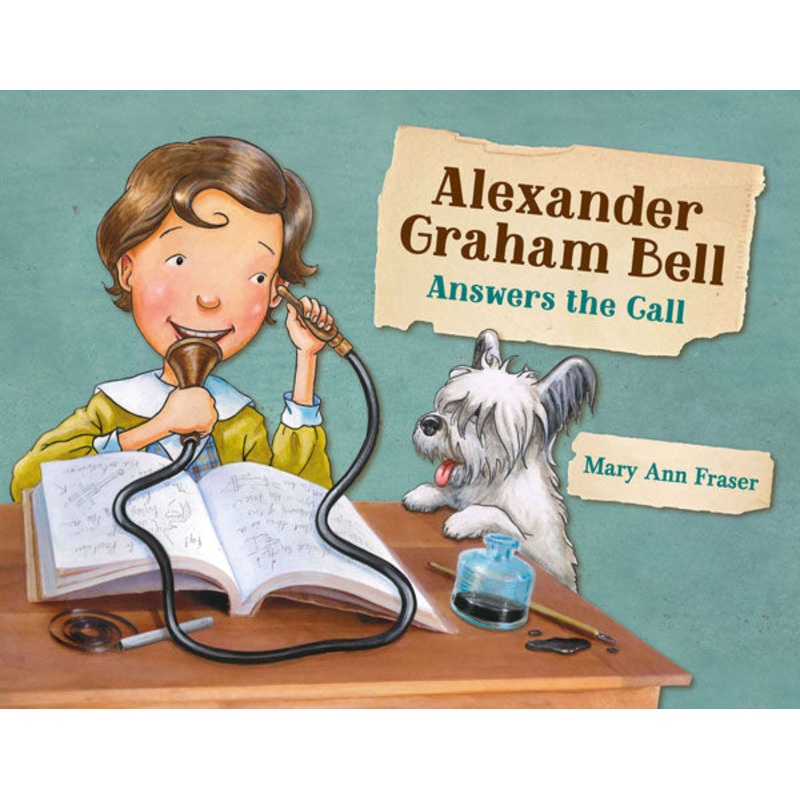
Written and illustrated by: Mary Ann FraserAlexander Graham Bell was destined to become a great inventor.Well before Alexander Graham Bell invented the telephone, Aleck (as his family called him) was a curious boy, interested in how and why he was able to
Flash Sale Ongoing
Written and illustrated by: Mary Ann Fraser
Well before Alexander Graham Bell invented the telephone, Aleck (as his family called him) was a curious boy, interested in how and why he was able to hear the world all around him. His father was a speech therapist and his mother was hearing impaired, which only made Aleck even more fascinated by sound vibration and modes of communication. Driven by curiosity and an eagerness to help others, Aleck became a teacher for the deaf. His eventual invention of the telephone proved that he never stopped thinking big or experimenting with sound.
If you like this book, youll enjoy these:
The Inventor’s Secret
Inventions That Could Have Changed the World… But Didn’t
The Day-Glow Brothers
Snowmobile: Bombardier’s Dream Machine
[TABS]
Mary Ann Fraser, author & illustrator
Mary Ann Fraser is a fiction and nonfiction illustrator as well as an author in her own right. She has worked on more than sixty books for children, including No Yeti Yet (Peter Pauper) and Heebie-Jeebie Jamboree (Boyds Mills).
Kirkus Reviews
From an early age “Aleck” (Bell’s family nickname) evinced an interest in sound and hearing, probably due to his father’s profession of speech therapy and his mother’s hearing loss. Aleck’s childhood experiences, observations, and experiments led to his careers, first as a teacher to the deaf and then as an inventor of the telephone. Aleck was determined to speed up communication and improve on the telegraph, first developed in the 1830s. The book’s accessible text focuses on his life up to and including the invention of the telephone in 1876, when he was 29. His later inventions are described in the backmatter, along with a chronology and an author’s note. The multimedia illustrations use photographic collage elements, friendly, slightly cartoony human figures, and sound effects and dialogue balloons on some pages. Photographic insets and diagrams further explain Bell’s work. This expands the content of the book and makes it appealing to both children looking for the story of Bell’s life and his lifelong curiosity and those more interested in scientific explanations. However, it lacks a bibliography. The front and rear endpapers are of particular note, depicting a photographic history of the telephone from 1876 to 1989 in sepia tone. The author’s note describes Aleck’s interest in photography and her own desire to incorporate photography in different ways in the book’s design. Calling out to history buffs and scientists, this will inspire young inventors.
School Library Journal
A look at the inspiration behind Alexander Graham Bells most noteworthy invention, the telephone. The book reveals much about Bells personal life and the driving force behind his inquisitive nature. Bells mother, Eliza, had lost most of her hearing as a child, and his father, Melville, was a speech therapist; young Bell is shown here contemplating how sound works and learning the two-handed manual alphabet to communicate with his mother. Many important events, including the collaboration between Bell and Thomas Watson, are conveyed in the form of a story, which makes the facts easy to digest for younger readers. Frasers multimedia artwork recalls Bells passion for photography, with some scenes resembling a snapshot. Text boxes are peppered throughout, giving readers more detailed explanations about how the ear works, the age of invention, and more. An authors note and further information about Bells inventions are appended. VERDICT Recommended for biography collections serving elementary school students.
Download the CoverDownload the Activity Guide
Hardcover
ISBN: 978-1-58089-721-1
E-book
ISBN: 978-1-60734-882-5 EPUB
ISBN: 978-1-60734-883-2 PDF
Ages: 6-9
Page count: 32
11 x 8 1/2
Correlated to Common Core State Standards:
English Language Arts-Literacy. Reading Literature. Grade 2. Standards 1, 2, 3, 4, 5, 6, 7, 8, 10
English Language Arts-Literacy. Reading Literature. Grade 3. Standards 1, 2, 3, 4, 5, 6, 7, 8, 10
[/TABS]

Reviews
There are no reviews yet.